Project / vuoro
Vuoro: governed work without a cockpit-shaped monolith
A working family of sprint, queue, knowledge, audit, and cockpit tools now composes into one served layer, without giving up explicit state ownership or machine-local execution.
Published Apr 9, 2026 / Revised Sep 7, 2026 / Verified Sep 7, 2026
Evidence
- State
- Published and in active use
- Verified
- Current capability
- Public tools own sprint, knowledge, queue, audit, and cockpit state through separate contracts, with local and shared operating modes. Dispatch is no longer a separate authority: the dispatch harness invokes product-native workers directly.
- Latest release or slice
- Served composition is at v0.1.59. The v0.1.52 image gated the work-schema v12 cutover — managed ActionQ schema v12 validated under the composition, with the sprintctl 0.3.0 reservation-model pin carried into the service image — and the v4 design freeze then rebuilt composition around explicit capabilities: uniform construction, the validator, and the migration itself. The releases since are adapter repins, including sprintctl 0.3.5, which closed a served authorization hole in reservation release.
- Supported integrations
- SQLite, PostgreSQL, agent-cockpit
- Known limitation
- kctl and auditctl have less operational mileage than sprintctl and the cockpit, and cross-repository drift is an observed condition rather than a risk: the shipped skills taught the deleted claim model until the 0.3.5 release corrected them. The v5 measurement is still not conclusive: oracle attainability is now enforced at dispatch time, and a first two-way scorecard exists, but its direct arm is not packet-isolated, so the comparison cannot yet attribute the difference.
- Next meaningful proof
- Produce a two-way comparison whose direct arm is packet-isolated. Until that holds, the composition can show that it advances safely but not that the work it governs got better.
On this page
Overview
sprintctl started with a mundane failure: humans and agents were editing the same Markdown sprint files, and agents kept pattern-matching against the wrong piece of prose. Better prompts reduced the frequency but did not change the failure mode. The durable fix was to move live sprint state into a schema and make a CLI the write authority.
kctl followed as the read-only knowledge path. It consumes sprint history, extracts durable and coordination candidates, and puts them through explicit review and publication. It does not silently turn every session note into canon, and it never writes work back into sprintctl.
Those two tools are still useful on their own. They are no longer the whole story. The same state-ownership rule has grown into Vuoro: each repository owns one operational domain, and agent-cockpit composes their read surfaces instead of becoming a new database with opinions about all of them.
The names carry separate meanings. Vuoro is the
public ecosystem label.
agentops remains the repository for shared contracts, cross-repository plans,
and the UI. agent-cockpit remains that UI. The public rename avoids confusing
the ecosystem with AgentOps.ai without churning implementation names.
Interactive system map
Explore the interactive Vuoro system map to follow the wider lifecycle across sprintctl, kctl, actionq, the retired actionq-dispatch, auditctl, deployment, and agent-cockpit. It focuses on state ownership and the handoffs between tools rather than treating the cockpit as the system itself.
Architecture and communication paths
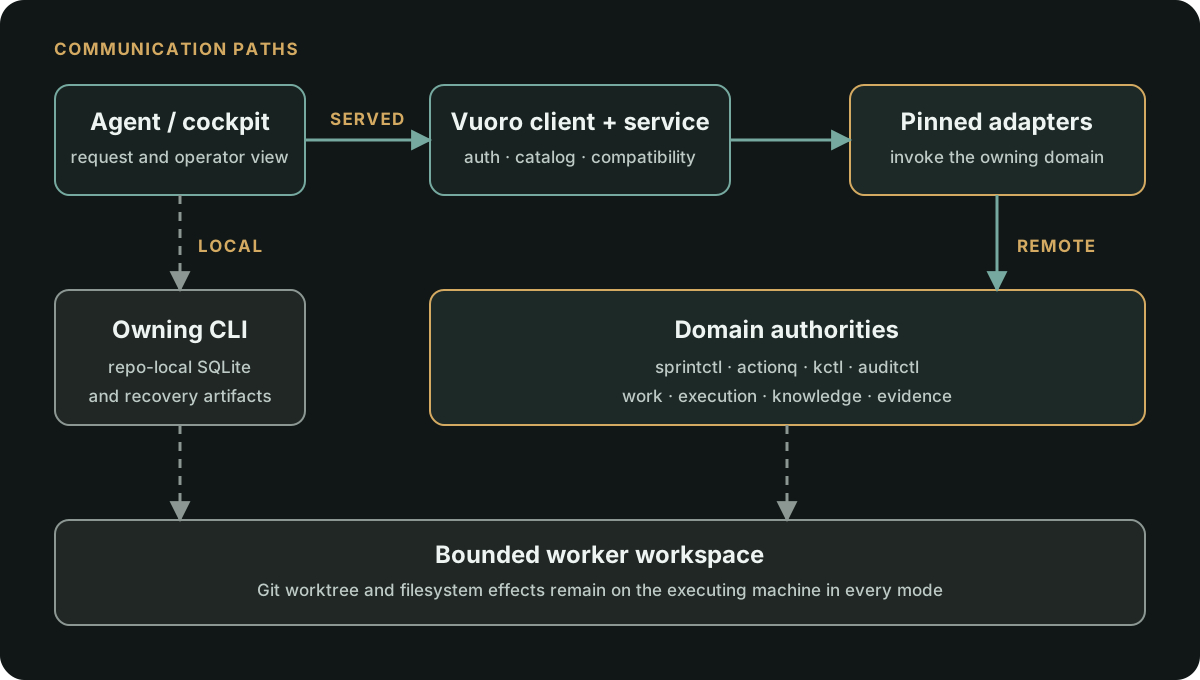
Three modes describe how a request travels, not three competing sources of truth. In local mode, an agent calls the owning CLI and keeps SQLite state, reservation and recovery material, Git worktrees, and filesystem effects on its machine. In remote mode, that same domain tool uses its shared PostgreSQL authority. In served mode, the transport-only Vuoro client talks to Vuoro service, which authenticates the caller, checks compatibility, and invokes a pinned adapter for the owning tool.
The modes compose. A served request can reach a remote authority while the worker that receives it still performs bounded Git and filesystem work locally. The cockpit reads projections and submits dispatch through the documented API; it does not gain a raw write path into the domain databases. None of these arrows promises a distributed transaction. Receipts, append-only events, idempotency, and explicit recovery carry work across the boundaries.
System shape
sprintctl owns sprints, work items, dependencies, events, reservations, and
handoffs. It runs against repo-local SQLite or a shared PostgreSQL backend, and
a declared backend mismatch fails rather than quietly opening a different source
of truth. Live coordination is a reservation ledger: a reservation is
session-bound and advisory, carries no bearer credential, and can be released,
reassigned, or interrupted by a maintenance sweep after an idle policy window.
The earlier claim/token model is gone as authority state — schema migrations
archived the claim rows into a history table, dropped the live claim table, and
nulled every token, so the archive records who held what and when without
retaining proof material. Its lineage lease_epoch survives only as a column of
that archive: historical structure, not downstream fencing. Resume and handoff
commands still turn live state into deterministic context for a new operator or
agent session.
kctl reads sprintctl events and owns the extraction, review, publication, and rendering of knowledge artifacts. The relationship is deliberately one-way. Rendered Markdown remains useful for review and Git history, but it is a projection, not the live control plane.
The sibling tools fill different gaps:
actionqowns PostgreSQL-backed action and session lifecycles with a strict queue contract and append-only events.actionq-dispatchformerly owned the bounded one-action coordinator: worktrees, worker invocation, path ACLs, pre- and post-gates, and result recording through the owning CLIs. It is retired as of 2026-08-20. The dispatch packet harness inagentopsnow constructs the bounded worktree, applies path and command policy, invokes one product-native worker, and runs the gates; actionq records provider references and observed status without spawning or supervising the process.auditctlowns a repo-local audit index plus durable daily NDJSON artifacts that can be rebuilt and read independently.agentopsowns reusable dispatch skills and schemas, cross-repository plans, and the agent-cockpit application. The cockpit reads sprint state, queue sessions, audit artifacts, and cost signals; its writes stay mediated by the owning domain contracts rather than direct database mutation.
The rule across the repositories is simple: state ownership decides repository ownership. It is also the main defense against building a cockpit-shaped monolith.
One work item, including failure
Here is the end-to-end property the system is designed to demonstrate:
- An operator creates a work item through sprintctl. Sprintctl records the item and event history.
- An agent takes a reservation. The reservation is session-bound and advisory — it makes ownership visible to every other session rather than proving it with a credential; the claim/token proof model it replaced survives only as archived history.
- Dispatch submits an action through actionq. The dispatch harness creates a bounded worktree, applies path and command policy, invokes one product-native worker, and runs its gates; actionq records provider references and observed status without spawning the process. Until its 2026-08-20 retirement, actionq-dispatch owned this coordination as a separate package.
- If the worker fails or returns an invalid result, the result is recorded as failed or rejected. It is not published and does not close the work item.
- The same session can resume its reservation; reassignment and release are explicit commands, and an idle reservation is interrupted by the maintenance sweep after a policy window. This is a visibility discipline, not a fencing guarantee — the proof-rotation rule retired with the claim model.
- Once a valid result clears independent verification, the owning CLI records completion and releases the reservation. Auditctl indexes portable evidence, and the cockpit projects the sprint, reservation, dispatch, and audit outcome.
This is an acceptance walkthrough, not a claim that the six steps form one atomic transaction. The schema transition that was this section’s next proof completed in August: the v0.1.52 image gated the cutover and managed ActionQ schema v12 was validated under the composition. The open proof has moved accordingly: oracle attainability is now checked at dispatch time and a first two-way scorecard exists, but its direct arm is not packet-isolated, so a comparison able to attribute the difference is still owed.
Current state
The tools are public and used across active repositories. sprintctl is on the 0.3.x reservation model with local and remote modes and provenance links; the resume outcome is tested end to end, though the single-command bundle surface is still a known gap — an operator currently assembles the continuation from a few calls. kctl has a functioning two-stream extraction and review pipeline. actionq supplies the queue and session read contracts, and auditctl emits portable audit shards. actionq-dispatch, the former one-shot coordinator, is retired; the dispatch harness invokes product-native workers directly.
The agent-cockpit is live and can show repository and sprint state, claims, session and dispatch lifecycles, audit outcomes, and bounded cost or model headroom signals. Its dispatch surface forwards work through actionq. sprintctl state and workspace artifacts remain separate service contracts rather than tables the UI is free to rewrite.
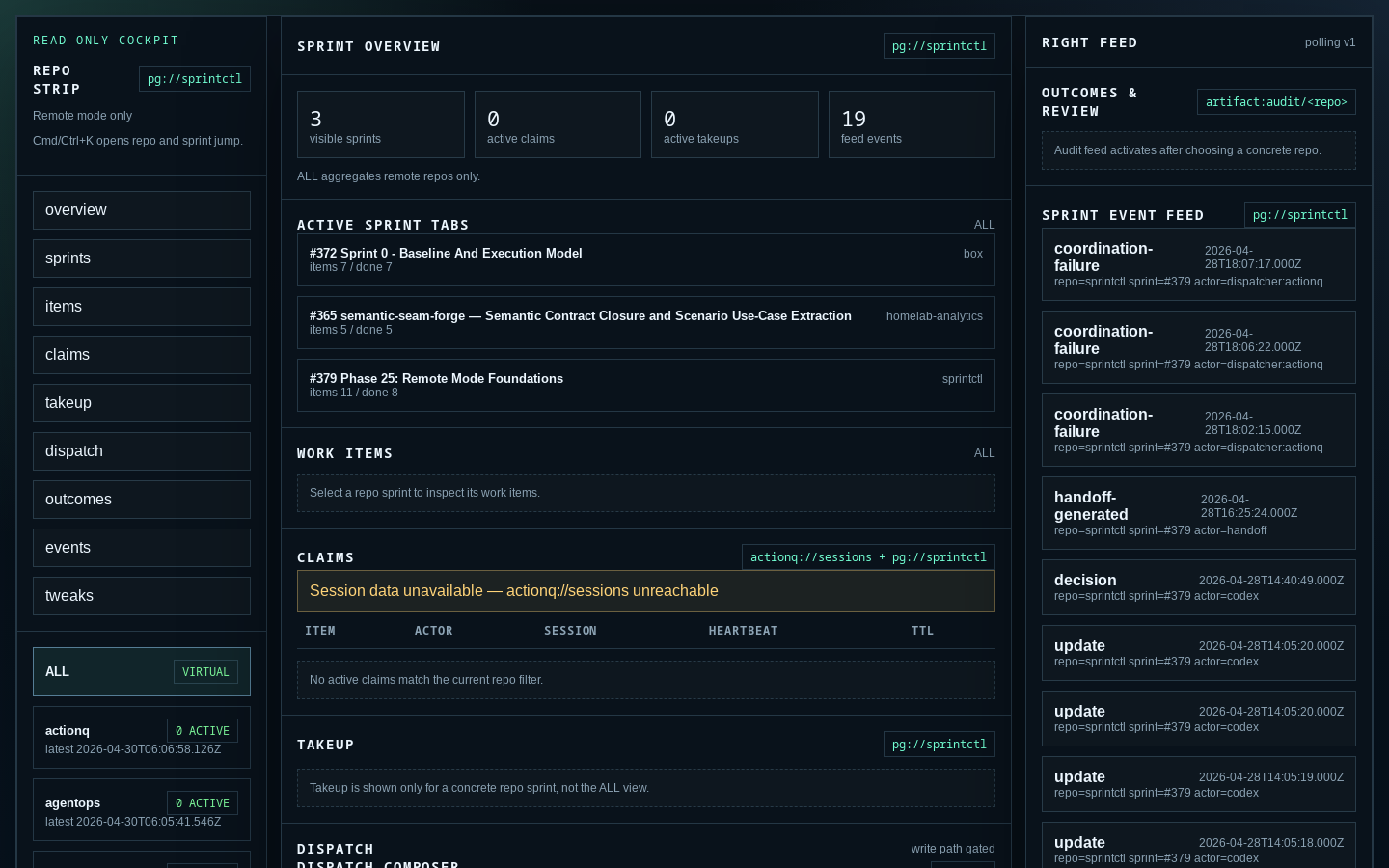
The screenshot is the current sprint overview: backlog and active work on the left, claim-aware work detail in the middle, and dispatch activity in the operator surface. It is a composed view of owning systems rather than a new state authority.
This is a different system from the original pair of pipx-installed SQLite tools. Local-first operation is still the default for a small repository, but PostgreSQL and agent-cockpit now provide a shared view when work crosses hosts or needs an operator surface.
By 8 August, served composition had reached v0.1.35 with component and schema compatibility made explicit. Four capability gates passed, while production preflight correctly rejected an unsafe schema-5 rollout. The maintenance bridge was staged to make the transition admissible without representing the production schema as already migrated. The transition staged there completed later that month: the v0.1.52 image carried the sprintctl 0.3.0 reservation-model pin and gated the work-schema v12 cutover, with managed ActionQ schema v12 validated under the composition. The composition has since advanced to v0.1.59 through adapter repins — sprintctl to 0.3.5, auditctl to 0.1.6 — verified against the running service on 2026-09-01.
Open edges
The substrate has enough parts that it must continually justify them. A tool designed to remove coordination ambiguity can recreate it through version drift, overlapping commands, or unclear recovery rules between repositories — and that is an observed condition, not a hypothetical: the shipped agent skills kept teaching the deleted claim model until the 0.3.5 release corrected them. Interface contracts and end-to-end verification matter more now than another feature in any one CLI.
kctl and auditctl are also less exercised than sprintctl and agent-cockpit. Their clean ownership boundaries are promising, but durable extraction and recovery need more operational mileage before they should be treated as settled.
The agent-cockpit write surface should stay narrow. Dispatch and explicit sprint operations are useful; turning the UI into a privileged backdoor around reservation, queue, or audit rules would recreate the original Markdown problem with better CSS.